Why does a living lexicon matter for regenerative co-design?
This living systems Design Lexicon bridges agricultural wisdom with design practice for regenerative, intercultural co-design.
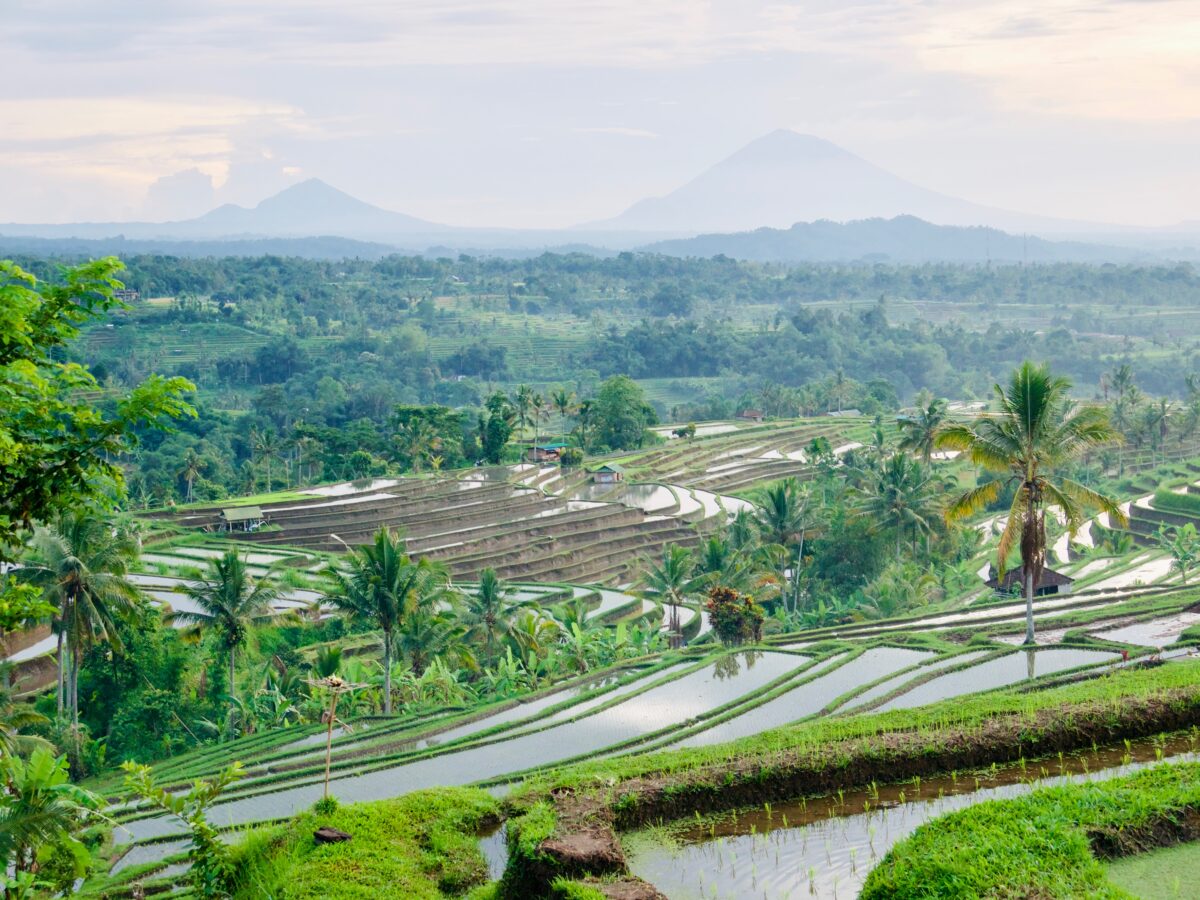
Our project looks specifically at post-harvest rice waste interventions, and this field vocabulary becomes a tool for re/worlding through a community-authored lexicon that prevents extractive approaches by helping designers recognise that rice husks, straw, and bran aren’t simply “waste materials” but integral components of regenerative cycles tied to soil health, animal feed systems, and seasonal ceremonies, exactly as local communities understand and prioritize these relationships. Without this shared conceptual vocabulary, design interventions risk perpetuating colonial patterns of appropriation while ignoring the intricate relationships between water management, seasonal rhythms, kinship networks, and agricultural cycles that define subak systems, the traditional Balinese cooperative water management system for rice terraces.
The lexicon enables international designers to understand community-selected concepts like Gotong Royong (collective work), Tri Hita Karana (three-way harmony), and Sate Penyepian (rest periods) as design principles rather than cultural curiosities and represents a fundamental departure from design’s extractive history. Rather than external researchers determining what knowledge to document, this dictionary emerged through community consultations with Indonesian academics, farmers, water managers, ritual leaders, and local knowledge holders.
This co-design approach transforms design collaboration from intervention to integration, creating pathways for equitable knowledge exchange and regenerative creative enterprise that honours traditional wisdom while addressing contemporary challenges, finally fulfilling the collaborative potential that has drawn visionary designers and thinkers to Indonesia for generations, but now on terms defined by the communities themselves. It embodies collective stewardship, ecological harmony, and community-based decision-making that has sustained landscapes for over a thousand years yet is at risk of disappearing to mismanaged development.
Special thanks to the agricultural team at Udayana University and for the Rice Culture Experts and informants (Ketut Suweden, Made Bakti Wiyasa & Sakagala Gema L) for insights into these community-determined practices learned in the following locations:
Project Locations
West Java: Bandung, Sumedang
Bali: Tabanan, Jati Luwih
Agriculture & Subak ecosystem

In this section are terms directly related to farming practices, irrigation and the structure of the Subak ecosystem.
| Terms | English | Bahasa |
|---|---|---|
| Andungan | Area of the rice field near a dam, functioning to filter sand. | Area sawah dekat bendungan untuk menyaring pasir. |
| Bedogan | A small water channel within the rice field irrigation system. | Jalur air kecil dalam sistem irigasi sawah. |
| Cakangan | A branching point in the irrigation system that divides the water flow into several directions. | Percabangan saluran air yang membagi aliran ke beberapa arah. |
| Nandur | The act of transplanting rice seedlings from the nursery to the field. | Memindahkan bibit padi dari lahan semai ke sawah. |
| Ngurit | The sowing of rice seeds in a designated nursery bed before being transplanted into the field. | Menyemai benih padi di lahan khusus sebelum dipindahkan ke sawah. |
| Pekaseh | The leader of a subak organisation, responsible for regulating irrigation and agricultural activities. | Pemimpin dalam organisasi subak yang bertanggung jawab mengatur pengairan dan kegiatan pertanian. |
| Pengalapan | The ritual act of collecting holy water for agricultural ceremonies. | Prosesi mengambil air suci untuk keperluan ritual pertanian. |
| Pengiwit | A ritual offering conducted at the subak temple before the planting season begins. | Upacara persembahan di pura subak sebelum masa tanam dimulai. |
| Pura Subak | A temple serving as the ritual centre of a subak, usually dedicated to Dewi Sri. | Pura yang menjadi pusat kegiatan ritual subak, biasanya dipersembahkan untuk Dewi Sri. |
| Sedahan | A member of the subak who oversaw the distribution of irrigation water for rice fields. | Bagian dari organisasi subak yang mengatur pembagian air untuk sawah. |
| Subak | A traditional Sundanese life principle signifying mutual care between humans and the surrounding environment. | Organisasi tradisional pengairan sawah di Bali, yang juga mengatur aspek sosial dan keagamaan masyarakat petani. |
| Subak Abian | Traditional Balinese agricultural organisation that manages dry fields (tegalan), usually planted with crops other than rice, such as coffee, coconut, or cloves. | Organisasi tradisional pertanian di Bali yang mengatur pengelolaan lahan kering atau tegalan, biasanya untuk tanaman selain padi seperti kopi, kelapa, atau cengkeh. |
| Tegalan | Dry agricultural land typically used for crops other than rice. | Lahan pertanian kering yang biasanya digunakan untuk tanaman selain padi. |
| Telabah | A larger irrigation canal compared to a bedogan. | Saluran air atau irigasi yang lebih besar dari bedogan. |
| Ulun suwi | A temple dedicated to Dewi Sri, associated with rice fertility. | Pura yang dipersembahkan untuk Dewi Sri, berhubungan dengan kesuburan padi. |
| Uma | Balinese term for irrigated rice fields. | Istilah dalam bahasa Bali untuk sawah beririgasi tempat menanam padi. Sawah dalam Bahasa Indonesia. |
Rituals, beliefs & symbolism
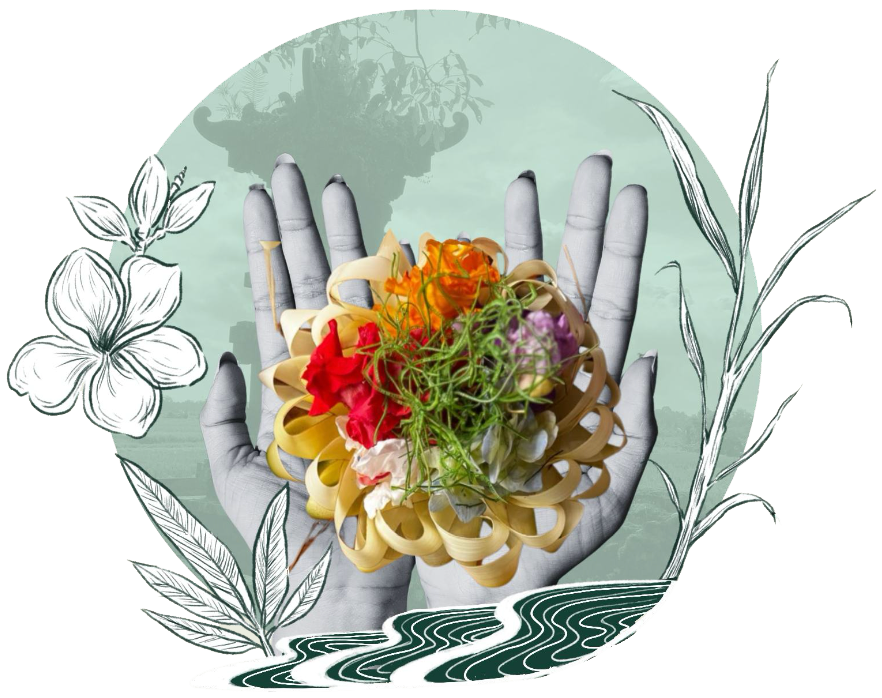
In this section are terms directly related to spiritual practices, offerings, ceremonies and sacred symbols.
| Terms | English | Bahasa |
|---|---|---|
| Awig-awig | Balinese customary (adat) law or traditional regulations. | Hukum/peraturan adat Bali |
| Ayahan | A form of obligatory labour performed by community members, usually within the context of subak or customary duties | Kewajiban kerja yang harus dilakukan oleh anggota masyarakat, biasanya dalam konteks subak atau adat |
| Banten | A Hindu-Balinese offering composed of flowers, fruit, arrangements of young coconut leaves, and other elements. A single banten consists of several types of canang. | Sesajian dalam Hindu-Bali yang terdiri dari bunga, buah, rangkaian janur, dan unsur lainnya. Satu banten terdiri dari beberapa jenis canang. |
| Biukukung | A ritual held during the rice’s flowering stage, intended to ask for divine protection against pests and diseases and to ensure a good harvest. | Upacara pada saat padi sedang bunting, dengan tujuan mernohon kepada Tuhan agar tanarnan padi terhindar dari serangan hama dan penyakit dan memberikan hasil yang baik. |
| Canangsari | One of the most common types of banten offered daily, usually containing four kinds of flowers, shavings of fragrant pandan leaves, and sweet foods or drinks. | Salah satu jenis Banten yang paling umum dihaturkan sehari-hari. Biasa berisi 4 jenis bunga, serutan daun pandan wangi, dan makanan/minuman manis. |
| Cili | A form of personification of Dewi Sri, represented as a small ornament made of young coconut leaves or rice cake. | Salah satu bentuk personifikasi dari Dewi Sri yang diwujudkan dalam bentuk hiasan kecil dari janur atau kue dari tepung beras. |
| Dewi Sri / Sanghyang Sri T | The wife of the god Vishnu (water), symbolising rice as the consort of water. | Istri dewa Wisnu (air), simbolisasi dari padi yang merupakan istri dari air. |
| Mantenin | A ritual performed before placing harvested rice into the granary. | Upacara yang dilakukan sebelum memasukkan padi hasil panen ke lumbung. |
| Mapag Toya | A ritual to welcome the first irrigation water entering the rice fields. | Upacara menyambut air irigasi yang pertama kali masuk ke sawah. |
| Ngendangin | A ceremony performed by farmers at the beginning of irrigating the rice fields. | Upacara yang dilaksanakan petani pada saat mulai mengairi sawah. |
| Ngayah | A system of communal voluntary labour in Balinese society, particularly in rituals and subak activities. | Sistem kerja bakti atau gotong royong dalam masyarakat Bali, terutama dalam kegiatan ritual dan subak. |
| Ngusaba | A ceremony performed when the rice begins to turn yellow. | Upacara yang dilakukan saat padi mulai menguning. |
| Ngusaba Desa | An annual village-level ceremony to pray for community safety, prosperity, and a good harvest. | Upacara tahunan di tingkat desa untuk memohon keselamatan dan kesejahteraan masyarakat serta hasil panen yang baik. |
| Niskala | The invisible, metaphysical world; part of the concept of sekala-niskala. | Yang tidak terlihat, dunia meta-fisik. Bagian dari konsep sekala-niskala. |
| Nyi Pohaci | A personification of Dewi Sri in Sundanese tradition. | Salah satu bentuk personifikasi dari Dewi Sri dalam tradisi Sunda. |
| Nuwasen | A propitious day chosen to begin the rice planting season. | Hari baik yang dipilih untuk memulai masa tanam padi. |
| Pelinggih | A sacred shrine in Hindu-Balinese religion that serves as the dwelling place of divine manifestations, deities, or ancestral spirits. It is found in temples, household compounds, and rice fields, functioning as a focal point for offerings and ritual ceremonies. | Struktur suci dalam agama Hindu-Bali yang berfungsi sebagai tempat bersemayamnya manifestasi Tuhan, dewa-dewa, atau roh leluhur. Dapat ditemukan di pura, pekarangan rumah, maupun di sawah, dan menjadi pusat persembahan serta upacara ritual. |
| Pengayah | A community member who performs ngayah or communal voluntary labour. | Anggota masyarakat yang melaksanakan kewajiban ngayah atau kerja bakti. |
| Plawa | Codiaeum variegatum. Commonly planted near shrines (pelinggih) in rice fields; used as a material for making penjor offerings. | Codiaeum variegatum. Sering ditanam dekat Pelinggih yang ada di sawah. Digunakan sebagai salah satu bahan untuk membuat Penjor. |
| Segara-giri | See: kaja-kelod. | Lihat: Kaja-Kelod. |
| Sekala | The visible, physical world; part of the concept of sekala niskala. | Yang terlihat, dunia fisik. Bagian dari konsep sekalaniskala. |
| Tri Hita Karana | A traditional Hindu-Balinese philosophy of life that regards harmony as the outcome of balanced relationships between humans, nature, and the divine. | Filosofi hidup tradisional Hindu-Bali yang mempercayai bahwa kebahagiaan hidup bersumber dari keseimbangan hubungan harmonis manusia dengan Tuhan (Parahyangan), manusia dengan sesama manusia (Pawongan), dan manusia dengan alam (Palemahan). Pengertian lurus: tri = tiga; hita = kebahagiaan; karana = penyebab. |
Community & Social Structure
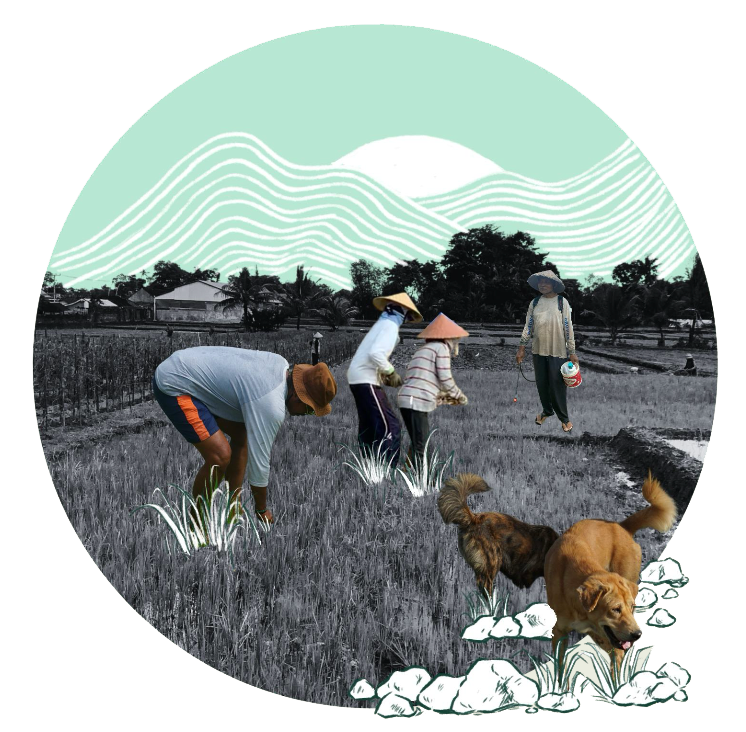
In this section, the terms refer to community organisation, mutual cooperation, and collective work systems.
| Terms | English | Bahasa |
|---|---|---|
| Andong | Cordyline fruticosa. Commonly planted near shrines (pelinggih) in rice fields; used as a ritual element in ceremonies dedicated to Dewi Sri. | Cordyline fruticosa. Sering ditanam dekat Pelinggih yang ada di sawah. Digunakan sebagai salah satu bahan sarana dalam upacara-upacara yang berkaitan dengan Dewi Sri. |
| Banjar | A traditional community organisation in Bali that functions as the centre for social, customary, and religious activities. | Unit organisasi sosial masyarakat Bali yang menjadi pusat kegiatan sosial, adat, dan agama. |
| Cakangan | A branching point in the irrigation system that divides the water flow into several directions. | Percabangan saluran air yang membagi aliran ke beberapa arah. |
| Gotong Royong | It is more than mutual cooporation – in Indonesia, it is an obligation of an individual towards society. | Lebih dari sekedar kerja sama timbal balik, di Indonesia, ini adalah kewajiban individu terhadap masyarakat. |
| Ngusaba Desa | An annual village-level ceremony to pray for community safety, prosperity, and a good harvest. | Upacara tahunan di tingkat desa untuk memohon keselamatan dan kesejahteraan masyarakat serta hasil panen yang baik. |
| Silih Asah | A traditional Sundanese life principle signifying the sharing of knowledge and skills. | Prinsip hidup tradisional Sunda yang berarti saling berbagi pengetahuan dan keterampilan. |
| Silih Asih | A traditional Sundanese life principle signifying mutual compassion among humans. | Prinsip hidup tradisional Sunda yang berarti saling mengasihi antara sesama manusia. |
| Silih Asuh | A traditional Sundanese life principle signifying mutual care between humans and the surrounding environment. | Prinsip hidup tradisional Sunda yang berarti saling menjaga dan merawat antara sesama manusia dan alam sekitar. |