Expressing and sustaining cultural identity through stories, rituals, and collaborative making practices.
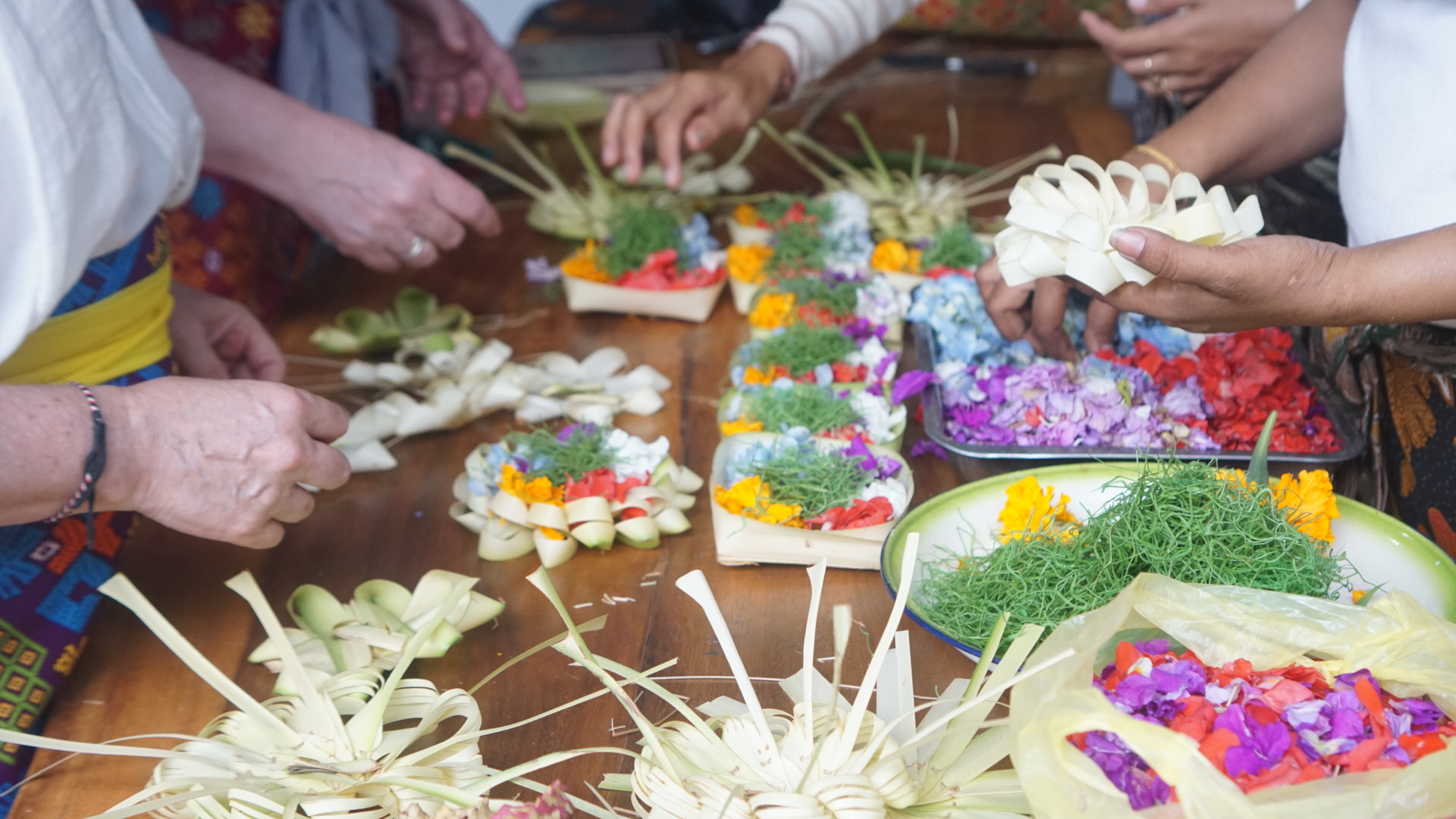
Reverse knowledge exchange by Dr Britta Boyer
Contemporary design research often presents itself as increasingly attentive to decolonial methods, collaboration, and community engagement. Yet the institutional structures that shape this work such as peer-reviewed publications, grants, design awards, and research metrics, continue to centre Western epistemic authority. In this framing, local and Indigenous knowledge holders are invited to “participate” in processes that nonetheless remain conceptually, methodologically, and evaluatively anchored in Western academic logics. Such practices risk reproducing the very coloniality they claim to dismantle, turning “decoloniality” itself into a form of academic capital.
This work with Dr Adhi Nugraha has highlighted how dynamics are encoded not only in practice but also in language. In Indonesian academic contexts, the type of engagement Western designers often call community work is not described as such. Instead, it is articulated as culture. This shift is not a linguistic curiosity but a profound epistemic divergence. Whereas “community work” implies an external engagement such as an academic or designer entering a social field to conduct research or implement a project, culture denotes an embedded, relational ontology. To work within culture is to navigate inherited obligations, reciprocal ethics, histories of kinship, and cosmological understandings of human and more-than-human relations. The term acknowledges the density of power, responsibility, and relational accountability that Western design discourse often obscures under the rhetoric of participation, co-creation, or stakeholder engagement. This observation underscores the colonial residue embedded in Western categories of “community,” “participation,” and “local engagement.” These terms, despite their progressive veneer, frame relational worlds as objects of intervention rather than autonomous epistemic territories. Dr Nugraha’s steering towards culture, instead of community, resists this reduction. It refuses the externalising logic that turns relationships into research sites and instead situates knowledge exchange within ontologies where relationality is not a method but a lived condition.
It is in this context that I propose the notion of reverse knowledge exchange. Rather than imagining knowledge to flow from Indigenous or local contexts into Western institutions for validation, reverse knowledge exchange positions local knowledge holders as epistemic centers who define the terms, methods, and purposes of relational work. This approach rejects the extractive impulse of collecting insights for external publication or institutional recognition. It also acknowledges the right of communities to refuse, limit, or reshape engagements according to their own cultural logics.
Reverse knowledge exchange is therefore not a mere methodological alternative but an epistemic repositioning that begins by questioning the universal applicability of Western design vocabulary itself. It recognises that terms like “community work” can do epistemic violence by flattening relational worlds into manageable units of intervention. In contrast, understanding these engagements as culture foregrounds the ontological depth of relational ethics and makes visible the asymmetrical power relations inherent in cross-cultural design collaborations. By centring culture rather than community, and by allowing local epistemologies to set the conditions of exchange, reverse knowledge exchange offers a way to rethink decolonial design practice beyond its current institutional capture. It asks what design research would look like if Western academia ceased to be the final arbiter of value and instead became one of many interlocutors within a pluriversal landscape of knowledge systems. It opens the possibility of design as a reciprocal, accountable, and culturally grounded practice, one in which the authority to name, frame, and define emerges from within the community-as-culture, rather than being imposed from outside.